MCC-Kansas City Maple Woods Agriculture Annex
Building a better community: MCC-Maple Woods opens doors to design-forward agriculture annex
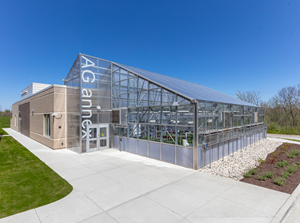
The $6 million, 9,452-square-foot MCC-Maple Woods Agricultural Annex built by
Universal Construction Company, Inc. includes a 2,100-square-foot connected greenhouse.
Photo courtesy Jacia Phillips, Arch Photo KC LLC |
The Missouri agriculture market is a vital part of the state’s economy, employing nearly 460,000 people in the state’s almost 88,000 farms. By providing a facility to educate future generations, Metropolitan Community College (MCC)-Maple Woods prioritizes the role higher education can play in continuing to enhance Missouri’s agriculture market.
MCC-Maple Woods has offered agriculture courses since Fall 2021 and continues to add courses each semester. The brand-new facility debuted in March 2025, and students may now pursue an associate in applied science (A.A.S.) degree in agriculture with emphasis options in agribusiness, plant science and animal science.
A key player in bringing the new Clark & Enersen-designed agriculture annex to life was the construction manager at risk, Universal Construction Company, Inc.
“At Universal Construction, our vision is to be ‘building a better community,’” said Senior Project Manager Gary Walker. “With the completion and opening of this facility, we have made that vision into a reality. The completion of this project will have a positive impact on future students, which will enhance the community.”
BRINGING EXPERIENCE AND INNOVATION TO THE TABLE
What made Universal Construction the construction manager at risk selection for the agriculture annex was their previous experience with higher education facilities.
“Universal Construction has completed similar projects with respect to the lecture hall and the laboratory classroom, but this was the first time building a greenhouse,” Walker said. “Previous experiences helped us know what questions to ask to ensure we were meeting the client’s expectations.”
The $6 million, 9,452-square-foot facility includes a 2,100-square-foot connected greenhouse, and it took approximately 10 months from the time Universal Construction mobilized until substantial completion of the facility.
“With every project Universal Construction works on, we create a custom plan that is fit to meet the needs for that particular project,” Walker stated. “We listen to the needs of our clients and then create a plan to meet those needs and expectations. We take great pride and honor in all our projects that we have completed since 1931.”
PLOWING THROUGH OBSTACLES
While constructing the annex, there were some obstacles that appeared in the process, ranging from system hacking to concrete floors.
At the same time Universal Construction was starting the project and pulling the building permit, Kansas City, Missouri’s municipal services were hacked, and the city temporarily stopped issuing permits. During this time, Universal Construction worked closely with the city to reduce the impacts on construction. After moving past the city-wide hacking outage, the team got started on concrete foundations and discovered rock.
“Rock was encountered while digging the concrete foundations and the deeper site utilities. These activities were going on while college was still in session,” Walker said. “To minimize the disruption caused to students, Universal Construction coordinated with the college and performed rock breaking operations during times when there would be minimal disturbance to classes.”
With these challenges met, Universal Construction worked with partners to apply creative solutions in the construction process, ultimately making Clark & Enersen’s design a reality.
“During the preconstruction planning phase, the architect and client wanted concrete polished floors, but they did not want to see the edge grinding marks that can be seen when concrete is polished after the interior walls have been placed,” Walker stated. “So, we developed a plan to achieve this result: polish the concrete floors prior to any of the interior walls being framed and then protect the finished concrete.”
Before completing the floor’s final polish, the team installed GoldiLox floor protection to the concrete. Installing this product allowed Universal Construction to lay out and build the walls directly on top of the GoldiLox to protect the concrete.
The team also used an autonomous floor scrubber to keep the floor protected and the project clean. As they approached the finishing stages of the project, the floor protection was pulled up and the concrete slab received its final polish.
CULTIVATING SUCCESS IN AGRICULTURE EDUCATION
The innovative design of the new Annex is so much more than meets the eye. It is a state-of-the-art facility offering hands-on and flexible learning opportunities for students.
“The main building also contains the mechanical room,” Walker said. “I know it may sound a little unusual to list the mechanical room, but this mechanical room feeds both the main building and the greenhouse.”
The mechanical, electrical and plumbing subcontractors’ work on the mechanical room stood out to Universal Construction.
“The subcontractors did an awesome job running all their lines and installing all their work neatly, professionally and with pride, which is something to be proud of,” Walker noted.
The greenhouse consists of a headhouse and two large grow rooms. The headhouse provides storage space and has room to start growing seedlings, which will get transferred
to one of the grow areas inside the greenhouse. The greenhouse is outfitted with its own set of specialized equipment, which includes temperature, humidity, watering and light controls. Each room of grow lights in the greenhouse can be controlled as well, so experiments can be conducted.
While the greenhouse is a separate building with its own structural design and components, it connects to the main building, creating one cohesive facility.
Listing a single element he is most proud of constructing at the MCC-Maple Woods Agriculture Annex is difficult for Walker.
“To me, the answer is the entire project. Although this is a single building, technically, it is two buildings combined into one. It was such a unique and one-of-a-kind project,” he said.
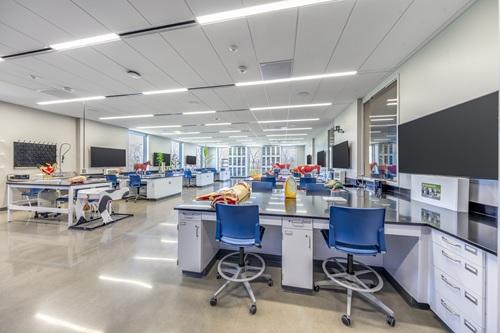
The innovative design of the new MCC-Maple Woods Agriculture Annex is so much more than meets the eye. It is a state-of-the-art facility offering hands-on and flexible learning opportunities for students. The lab classroom pictured here is designed for animal science and plant science lessons. Photo courtesy Jacia Phillips, Arch Photo KC LLC
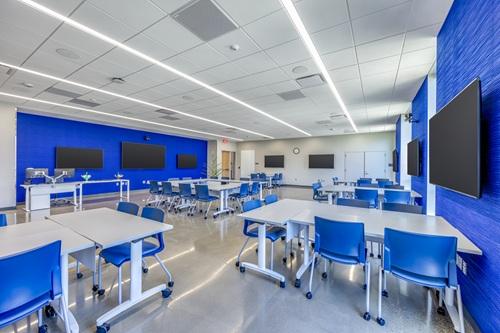
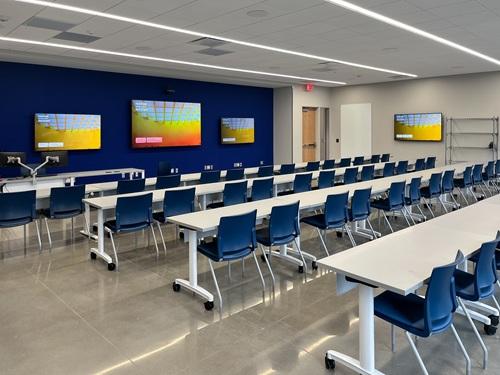
The main building contains flexible space for a large lecture hall and classroom. Audio and video equipment
allows students to participate remotely. Photo courtesy Jacia Phillips, Arch Photo KC LLC
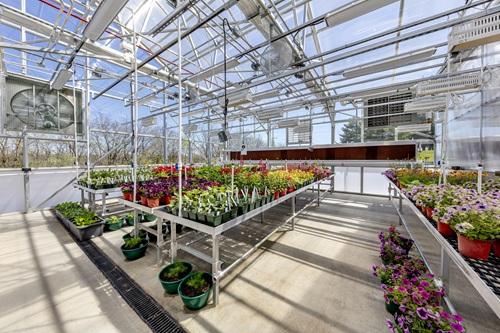
While the greenhouse is a separate building with its own structural design and components, it connects to
the main building, creating one cohesive facility. Photo courtesy Jacia Phillips, Arch Photo KC LLC
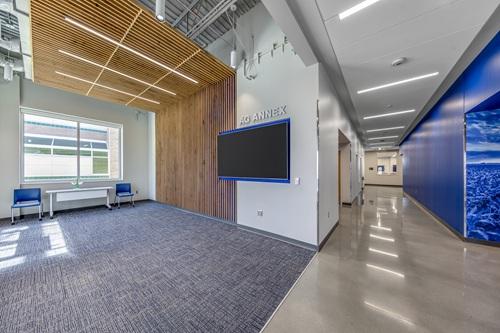
During the preconstruction planning phase, Universal Construction developed a plan to polish the concrete floors before interior walls were framed, taking care to protect the floors during the rest of construction. This system eliminated the grinding marks that are typically seen when concrete is polished after the interior walls have been placed. Photo courtesy Jacia Phillips, Arch Photo KC LLC
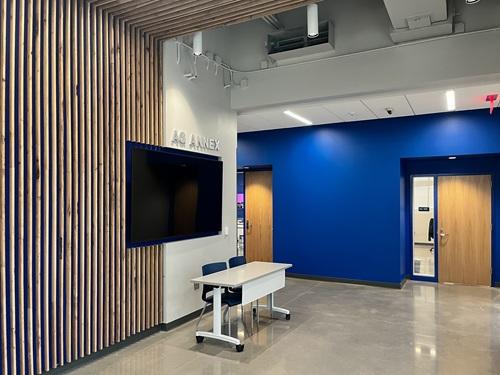
By providing a facility to educate future generations, Metropolitan Community College (MCC)-Maple
Woods prioritizes the role higher education can play in continuing to enhance Missouri’s agriculture market. Photo by Zak Smith
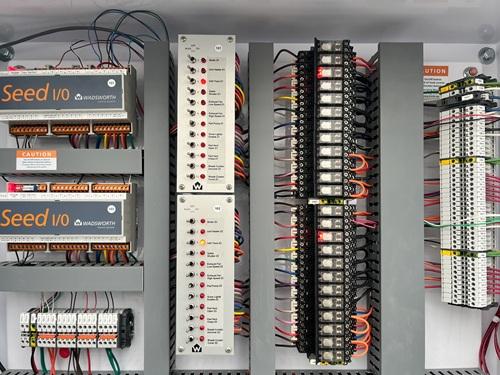
The greenhouse is outfitted with its own set of specialized equipment, which includes temperature,
humidity, watering and light controls. Photo by Zak Smith
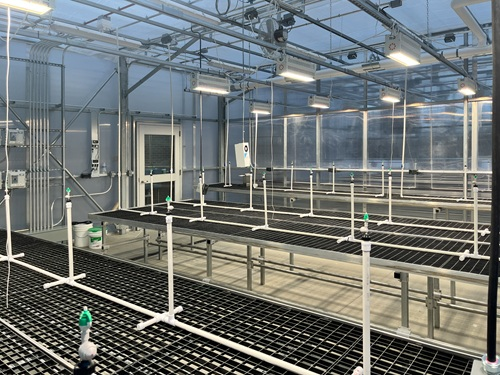
Independently controlled grow lights allow experiments to be conducted in the greenhouse spaces. Photo by Zak Smith
Completed in March of 2025, the new facility allows students to pursue an associate in applied science
(A.A.S.) degree in agriculture with emphasis options in agribusiness, plant science and animal science. Photo by Zak Smith
❮
❯